Which cities are leading China's next innovation wave?
Investment is accelerating across the full stack of AI and industrial capabilities amid mutually reinforcing trends. China is creating a series of “tech flywheels” where each wave of capital expenditure catalyses further demand across adjacent sectors, amplifying growth across the ecosystem and the country. Ten cities. Five themes. One innovation story.
Click on the map to discover five themes and ten highlighted companies.
Overview
Ask any Chinese about Jiangsu and they’ll likely mention the classical gardens of Suzhou or the imperial history of Nanjing, the “capital of the South”. The tourist guides paint a province of canals, silk and scholar-officials. Yet behind this genteel image lies one of the world’s densest concentrations of computing infrastructure: Jiangsu’s industrial parks now host the chip packaging, optical components and server manufacturing that quietly underpin China’s AI ambitions. While others claim the headlines with their model labs, it is Jiangsu that builds the machinery of the intelligence age.
Jiangsu’s maker belt: quietly powering AI and electrification
Wuxi Lead Intelligent Equipment
Wuxi, Jiangsu
The company has developed AI driven, fully automated battery manufacturing equipment, significantly improving yield, uptime, and scalability.
Did you know?
At the March 2026 InterBattery Innovation Awards in Seoul, Wuxi Lead won the Equipment Award for its Dry Mixing & Coating System (a key enabler for future, greener next-generation battery production), the only non-Korean company honoured and the first Chinese company ever to win the award.
Source: PR Newswire, March 2026
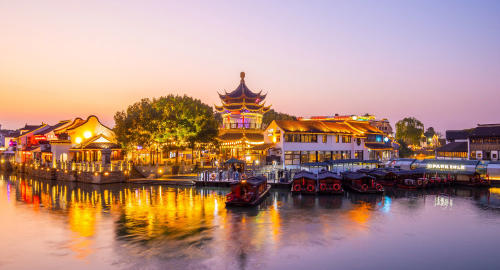
Shantang Street, Suzhou
Jiangsu’s maker belt: quietly powering AI and electrification
Zhongji InnoLight
Suzhou, Jiangsu
Zhongji InnoLight is leading developments in high-speed optical modules, commercialising 800G, an ultra-high-speed network communications technology. This places Innolight at the junction of compute demand and energy constraints, where optical modules are a clear winner.
Did you know?
One of the world’s dominant maker of the optical transceivers that link GPUs in AI data centres, Zhongji Innolight is now accelerating mass production of 1.6-terabit modules (twice the speed of today’s 800G workhorses) with 1.6T siliconphotonics transceivers entering mass production in early 2026, just as the industry shifts from copper to light to handle AI workloads.
Source: ip-fiber.com, November 2025
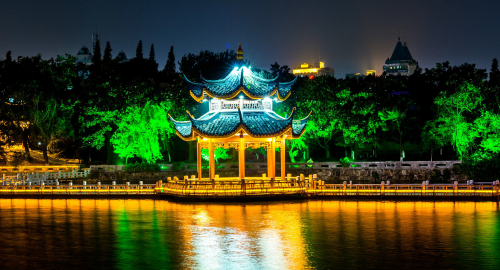
Wenfeng Pagoda, Nantong
Jiangsu’s maker belt: quietly powering AI and electrification
Jiangsu Zhongtian Technology (ZTT)
Nantong (Rugao), Jiangsu
ZTT is an innovator in specialty optical fibre and submarine cable systems, enabling long distance, high-capacity power and data transmission. With a growing focus on high-end optical fibre, the company is well positioned to benefit from the optical fibre upcycle driven by accelerating AI datacentre infrastructure buildout, alongside structural tailwinds from electrification, offshore wind expansion, and rising cross-regional power transfer.
Did you know?
ZTT recently won the contract for a ±500kV DC submarine cable system; with a length of116.5 km and capable of carrying 2 GW – enough to supply millions of homes – it is one of the most ambitious HVDC submarine cable projects in Asia.
Sources: ZTT, tgs4c.com, March 2025
Fujian conjures images of oolong tea; Hubei is known for the Three Gorges Dam; Shandong for Confucius and Tsingtao beer. But these three provinces have become the backbone of advanced manufacturing, from new materials and optoelectronics in Wuhan’s “Optics Valley” to Shandong’s chemical and heavy-industry base, feeding everything from wind turbines to semiconductors. They are a reminder that industrial leadership is built less on flagship campuses than on deep, layered supply chains.
Xiamen TungstenXiamen, Fujian
Hubei DinglongWuhan, Hubei
Yantai JerehYantai, Shandong
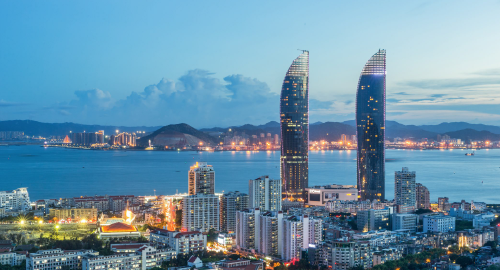
Xiamen Shimao Straits Tower
Materials and manufacturing depth: Fujian, Hubei, and Shandong
Xiamen Tungsten
Xiamen, Fujian
Advanced high purity tungsten and rare earth materials are critical inputs for EVs, industrial tooling, and electronics, placing Xiamen Tungsten at the core of China’s critical materials supply chain.
Did you know?
Xiamen Tungsten is one of the world leaders in ultra-fine tungsten wire (thinner than a human hair!) used to slice silicon wafers for solar panels. Its capacity has reached 84.5 billion metres per year, and a new expansion project will lift total capacity to 184.5 billion metres annually. That’s roughly 184 million kilometres of wire a year, more than the distance from the Earth to the Sun.
Source: Futu News, Cailian News, November 2025
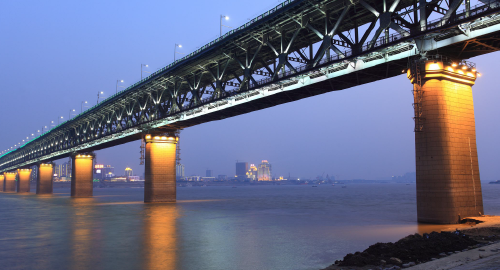
Yangtze River Bridge, Wuhan
Materials and manufacturing depth: Fujian, Hubei, and Shandong
Hubei Dinglong
Wuhan, Hubei
Hubei Dinglong is a producer of highperformance chip polishing chemicals and materials, enabling the domestic substitution of a critical semiconductor input.
Did you know?
In March 2026, Dinglong began mass production at China’s first full-process photoresist plant, in Qianjiang, Hubei; photoresists are a key component in the making of high-end memory chips.
Source: Yicai Global, March 2026
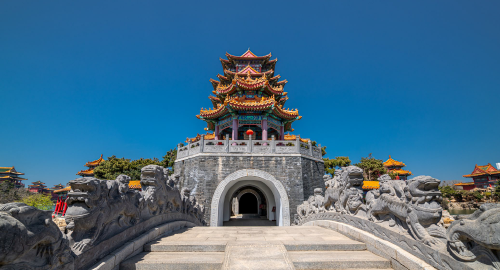
Penglai Pavilion, Yantai
Materials and manufacturing depth: Fujian, Hubei, and Shandong
Yantai Jereh
Yantai, Shandong
Yantai Jereh is transitioning beyond more traditional oilfield equipment to become a critical supplier of gas turbine integrated power solutions for AI datacentres, while remaining an innovator in intelligent digital oilfield equipment and LNG solutions.
Did you know?
Jereh achieved a landmark breakthrough into the North American AI datacentre market in late 2025. It became the first China A-share equipment company to announce integrated gas turbine power solutions, alongside multi-million-dollar contracts, with US hyperscaler data centres.
Source: Yicai Global, March 2026
Anhui was long dismissed as a poor agricultural hinterland, and Fujian’s Ningde was an obscure coastal prefecture few outside China could place on a map. Today they form a crescent of battery power: Ningde gave the world CATL, the largest battery maker on the planet1, while Anhui’s capital Hefei has bet boldly on EVs and energy storage. What looks like provincial backwater on a tourist map is, in fact, the beating heart of the global energy transition.1 Source: CNBC, June 2025
The “Battery Crescent”: Fujian and Anhui come of age
Contemporary Amperex Technology (CATL)
Ningde, Fujian
CATL is pioneering ultra-fast charging and high energy density EV batteries, plus sodium ion chemistry, improving range, safety, cold weather performance, and charging speed. Its continued innovation has led to its addressable market expanding from EVs to grid-scale storage.
Did you know?
At CATL’s annual Super Technology Day in April 2026, the company unveiled a breakthrough battery enabling an EV to drive 1500km on a single charge, paired with ultra-fast charging that can reach 80% in less than 5 minutes.
Sources: CATL, cnevpost.com, April 2026
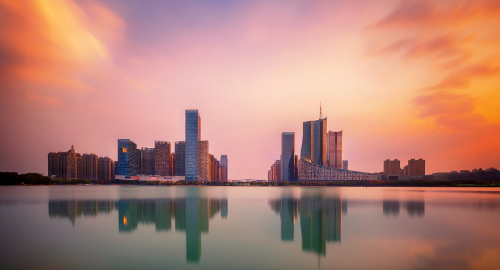
Swan Lake financial business district, Hefei
The “Battery Crescent”: Fujian and Anhui come of age
Sungrow Power Supply
Hefei, Anhui
Sungrow’s advanced modular solar inverters and power control technologies are enabling greater efficiency, faster maintenance, and better grid stability for large scale solar and energy storage systems.
Did you know?
In May 2026, Sungrow secured a landmark supply contract for Abu Dhabi’s first gigascale round-the-clock renewable energy project, supplying 7.5GWh of liquid-cooled energy storage - equivalent to powering a large city for several hours - alongside 2.6GW of solar power inverters. This project is designed to deliver stable 24/7 clean baseload power for industrial users and power-hungry digital infrastructure.
Sources: CATL, cnevpost.com, April 2026
Mention the Greater Bay Area and the mind jumps to Shenzhen’s consumer electronics, Hong Kong’s finance or Guangzhou’s trade fairs. Less noticed is the region’s emergence as a biotech powerhouse: genomics pioneers, contract research giants and a fast-growing cluster of drug developers are turning the Pearl River Delta into Asia’s answer to Boston. The hardware capital of the world is quietly learning to engineer biology as fluently as it engineers circuit boards.
AkesoZhongshan, Guangdong
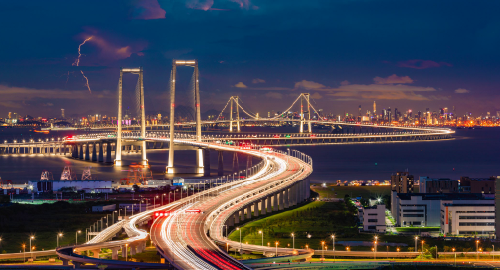
Shenzhen–Zhongshan Link
The Greater Bay Area: beyond the usual suspects
Akeso
Zhongshan, Guangdong
A pioneer in first-in-class bispecific antibodies, Akeso is delivering breakthrough therapies across oncology and neurodegenerative diseases, helping to drive Chinese developed drugs onto the global stage.
Did you know?
Akeso out-licensed its breakthrough cancer drug ivonescimab to global partner Summit Therapeutics in a deal worth up to US$5 billion. This is one of the largest licensing agreements, highlighting the rising value of China biotech innovation worldwide.
Source: PR Newswire, December 2022
Chengdu is famous for pandas, teahouses and a laid-back lifestyle that locals proudly contrast with the coastal grind. Yet Sichuan’s capital sits at the centre of one of the world’s great energy systems, a vast hydropower network feeding ultra-high-voltage transmission lines that carry clean electricity across thousands of kilometres to China’s eastern megacities. The city of leisure is, paradoxically, the nerve centre of a hard-working grid in China.
Dongfang ElectricChengdu, Sichuan
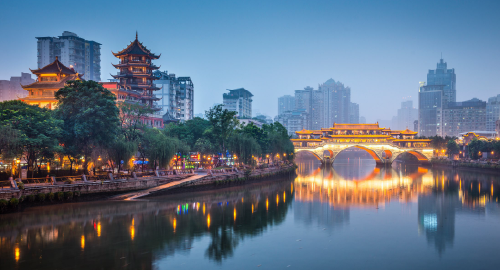
Anshun Bridge, Chengdu
Western momentum: Chengdu’s gridscale ambition
Dongfang Electric
Chengdu, Sichuan
Dongfang Electric is a manufacturer of advanced large scale power equipment, including gas turbines, offshore wind, hydropower, and nuclear components. Supporting energy transition and grid reliability, Dongfang’s products are key to the grid upgrades and generation capacity needed for AI-driven electricity demand.
Did you know?
In late 2025 Dongfang finished installing its 26MW offshore wind turbine - enough capacity from a single unit to rival a small conventional power plant – making it the world’s largest by single-unit capacity and rotor diameter. Its rotor spans over 310 metres, wider than the Eiffel Tower is tall.
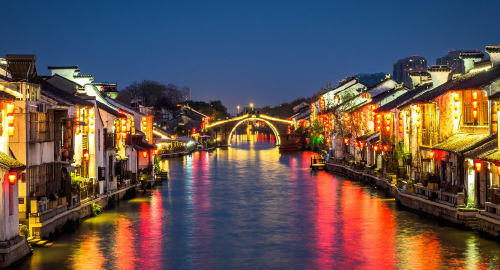 Qingming Bridge, Wuxi